Age‑Appropriate Design: Recommended Distances, Rail Heights, and Clearances for Safe Play
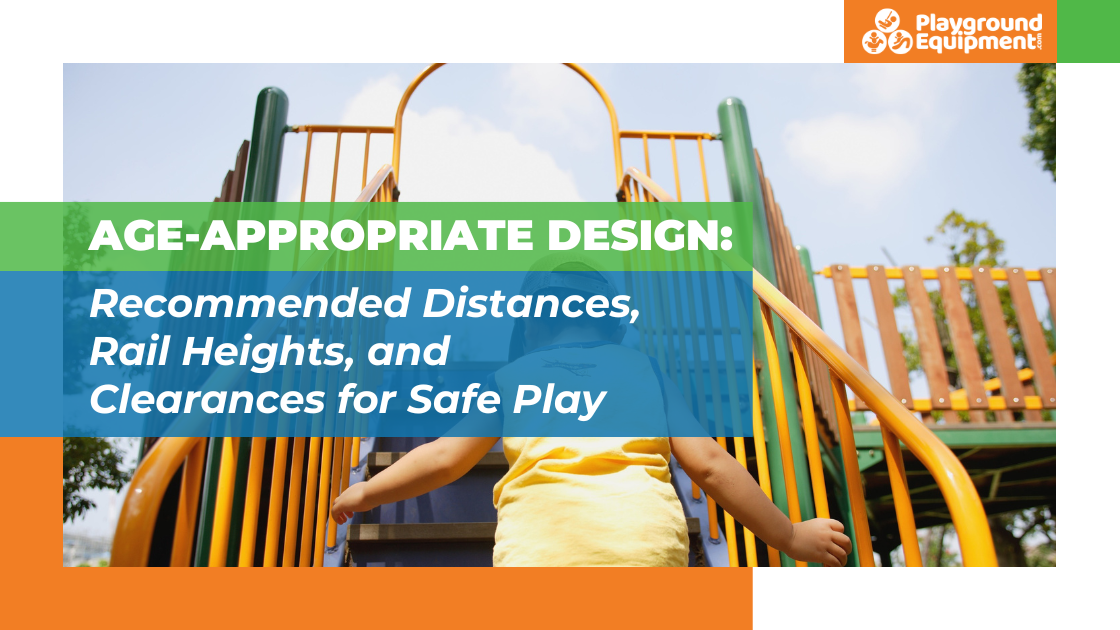
If kids ruled the world, every surface would be a slide, every wall a climbing net, and the laws of gravity would be optional. But until that day comes, it’s our job to ensure that playgrounds are not just fun but also safe, smart, and suited to every stage of childhood development.
At PlaygroundEquipment.com, we believe that safe play is smart play. Our mission is to design and deliver play environments that ignite imagination, fuel active play, and—most importantly—protect children as they grow, along with our decades of experience and passion for purposeful design.
Let’s dive into the details that transform a good playground into a great one—one that’s tailored to the needs of every age group.
Understanding Age-Appropriate Design: Why It Matters
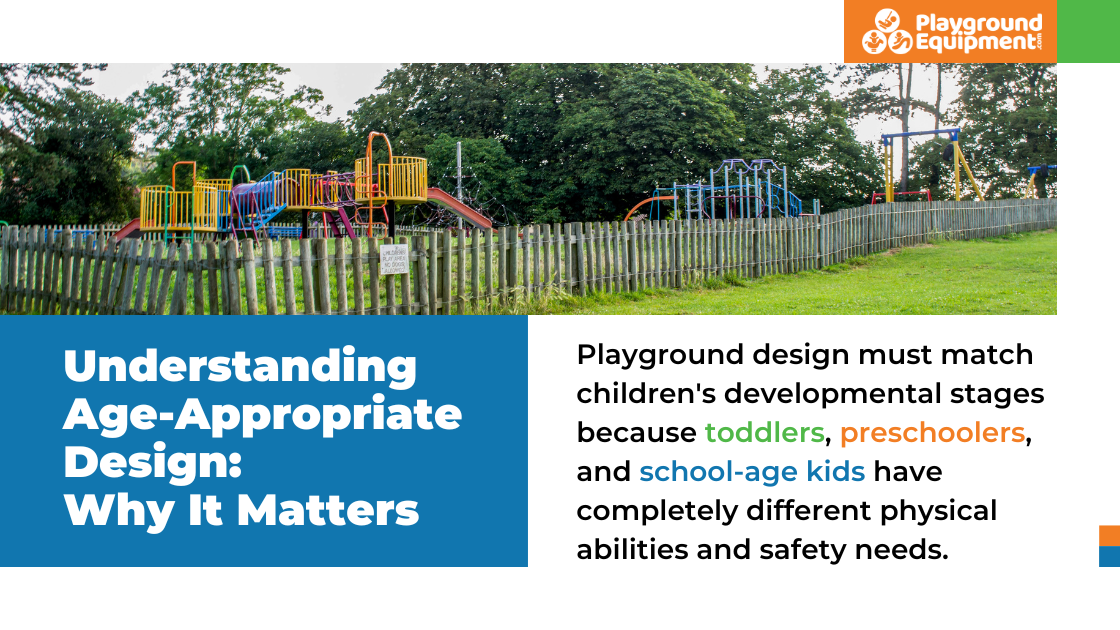
Designing a playground isn’t just about choosing colorful slides and swing sets. It’s about creating an environment that aligns with the physical, cognitive, and emotional development of children at different ages.
The Three Core Age Groups in Playground Design
According to the Consumer Product Safety Commission (CPSC) and ASTM International, playgrounds should be designed with three primary age groups in mind:
- Infants and Toddlers (6–23 months)
- Preschoolers (2–5 years)
- School-age children (5–12 years)
Each group has distinct needs in terms of equipment size, fall height, and spatial layout. For example, toddlers benefit from low platforms and enclosed spaces, while school-age kids thrive on more challenging, open-ended structures.
At PlaygroundEquipment.com, we tailor our designs to meet these developmental needs, ensuring that every child has access to safe, stimulating play.
Recommended Distances: Space That Supports Play
Fall Zones
Playground safety guidelines require clear “fall zones” around slides, swings, climbers, and other elevated play components. These are the buffer areas that absorb energy if a child falls or jumps.
- Slides: At least 6 feet of clearance from the slide exit.
- Swings: Twice the height of the swing beam in front and back. For an 8-foot swing, that’s a 16-foot clearance on each side.
These distances prevent collisions, allow for natural play patterns, and keep children from running into one another in high-motion areas.
Equipment Spacing
Overcrowding playgrounds is a common mistake. When equipment is installed too close together, children risk colliding or getting trapped between structures.
- 2–5 Age Group: Smaller equipment requires a minimum 6-foot separation.
- 5–12 Age Group: Larger structures may need 9 feet or more of clearance.
At PlaygroundEquipment.com, we carefully balance density and flow to maximize play value without sacrificing safety.
Rail Heights and Barriers: Preventing Falls at Every Stage
Handrails and guardrails are a playground’s invisible guardians. They’re designed not only to prevent falls but also to give children just enough security to build confidence as they climb.
Toddlers (6–23 months)
- Low Platforms: No more than 32 inches high.
- Rails: Full barriers with small openings to prevent entrapment.
Preschool (2–5 years)
- Guardrails: Required for platforms 20–30 inches high.
- Protective Barriers: For platforms above 30 inches, full enclosures are recommended.
School-Age (5–12 years)
- Guardrails: For platforms up to 48 inches.
- Protective Barriers: Beyond 48 inches, to keep adventurous climbers secure.
The goal is to let kids stretch their limits in a safe environment. A 3-year-old exploring a play deck with a protective barrier feels secure, while a 10-year-old can test balance skills on a higher platform with guardrails.
Clearance Considerations: Space to Move, Grow, and Play
Clearances aren’t just about avoiding bumps and bruises. They’re about giving kids room to explore freely and safely.
Critical Clearance Zones
- Overhead Clearance: Ensure at least 84 inches of vertical clearance for overhead equipment like monkey bars or climbers.
- Slide Exits: Provide a minimum of 6 feet of clear space at the bottom of slides.
- Moving Equipment: Items like merry-go-rounds or swings need ample clearance from nearby structures, fences, or other equipment.
Entrapment Hazards
Openings should be either too small or too large to prevent a child’s head or limbs from getting stuck. Avoid openings between 3.5 inches and 9 inches in diameter.
PlaygroundEquipment.com uses advanced CAD modeling and field-tested layouts to ensure every piece of equipment meets these clearance requirements because safe play starts with smart design.
Designing for Growth and Development
Safety standards aren’t arbitrary—they’re based on how children develop physically, socially, and cognitively. Aligning distances, rail heights, and clearances with age group needs supports healthy growth.
For Younger Children
- Gross Motor Skills: Low platforms and short slides encourage climbing and balance without overwhelming.
- Confidence Building: Barriers and close railings let them feel secure as they explore.
For Older Children
- Challenge Seeking: Taller structures, overhead climbers, and complex nets allow kids to test strength and coordination.
- Social Play: Larger clearances support group interaction and cooperative games.
The right design invites kids to push their limits safely, which builds confidence and joy.
Practical Advice for Planners and Communities
Designing with age-appropriate clearances and rail heights can feel technical, but the process becomes smoother with a few key strategies:
- Start with Age Group Priorities: Identify whether your site serves mostly preschoolers, school-age children, or both.
- Plan Separate Zones: Distinct play areas prevent toddlers from wandering into equipment meant for older kids.
- Invest in Surfacing: Impact-absorbing materials should extend through every fall zone and clearance.
- Use Expert Guidance: Rely on reputable manufacturers like PlaygroundEquipment.com, who can provide exact specifications for each product.
Following these steps ensures that the playground is not only safe but also engaging and sustainable long-term.
Why PlaygroundEquipment.com Is the Trusted Source
Great playgrounds don’t just happen by accident. They happen by precision and design. By following age-appropriate recommendations for distances, rail heights, and clearances, you create spaces where children can play freely and parents can rest easy.
At PlaygroundEquipment.com, we’re proud to be your partner in this mission. Our team of experts is ready to help you design, plan, and build a playground that checks every box from safety compliance to creative innovation.
Contact us today, and let’s build a space where safe play knows no bounds.
Unlock the Secrets of Great Play Spaces Through These Expert Picks
- For more ways of selecting flexible and age-appropriate playground equipment:
How to Choose Age-Appropriate Playground Equipment for Mixed-Use Spaces - PlaygroundEquipment.com
- For more inclusive swing sets and playset designs:
Playground Fun for All: Inclusive Design Ideas For Swing Sets and Playsets - PlaygroundEquipment.com
- Know the importance of neutral colors for your playground designs:
Neutral Playground Designs: When and Why to Choose Subtle Color Palettes - PlaygroundEquipment.com
- Learn how ASTM standards define playground equipment and design rules:
- Learn more about children’s favorite sliding playground equipment:
Learn About the Author

A CPSI-certified playground inspector, Nic has been with PlaygroundEquipment.com for over three years. Nic has a keen interest in playground design, construction, and installation, and he uses this passion to drive his work to new heights. In his free time, Nic enjoys hanging out with friends and living life to its fullest.
Nic on linkedin