What’s the Ideal Size for a School Playground?
Some say it’s not the size of the playground that matters—it’s how much joy you can fit into it. While that’s a sweet sentiment, at PlaygroundEquipment.com, we also know that the right size truly matters when it comes to safety, functionality, and creating a space that inspires happy, active kids.
From compact urban campuses to sprawling suburban schools, planning the ideal playground size is both an art and a science. Let’s break down the essentials so you can design a play area that’s as smart and safe as it is fun.
Understanding the Basics: Why Playground Size Matters
The size of your school playground does more than determine how many swings you can fit. It influences safety, accessibility, engagement, and even behavior. A well-sized playground allows children to explore freely without overcrowding, promotes active play, and reduces the risk of accidents.
According to industry standards and our design expertise at PlaygroundEquipment.com, schools should plan for at least 75–100 square feet per child on the playground at one time. This ensures enough room for dynamic play while maintaining safety zones around equipment.
For example, if your school anticipates 100 children on the playground during recess, you’ll want at least 7,500 to 10,000 square feet of play space. This doesn’t mean every inch has to be filled with equipment— open, flexible areas are just as valuable for games, socializing, and imaginative play.
And that’s just the starting point. The “ideal” size ultimately depends on your school’s specific goals, student age range, and the types of play experiences you want to offer.
Factors That Influence Playground Size
Every playground is unique. The ideal size depends on several key factors beyond just student population.
1. Age Group of Children
Younger children (ages 2–5) require smaller, more contained play areas with equipment scaled to their developmental needs. Older kids (ages 5–12) need more space for running, climbing, and exploring.
At PlaygroundEquipment.com, we design age-appropriate zones to ensure each child has the freedom to play safely and confidently. Mixed-age playgrounds often require additional space to separate equipment and reduce the risk of injury.
2. Type of Play Equipment
The more elaborate the equipment, the more space you’ll need. A sprawling obstacle course or multi-level climbing structure demands more square footage than a simple swing set or sandbox.
We recommend prioritizing equipment that offers maximum play value in a compact footprint. Modular systems, for example, can deliver diverse play experiences without overwhelming your available space.
3. Site Constraints and Layout
Is your playground located on a flat, open field? Or are you working around existing buildings, trees, or slopes? Site-specific features can dramatically affect how much usable space you actually have.
Our design team at PlaygroundEquipment.com specializes in custom layouts that maximize every inch of available space. From creative landscaping to smart equipment placement, we help schools overcome spatial challenges with style.
Recommended Playground Space by Age Group
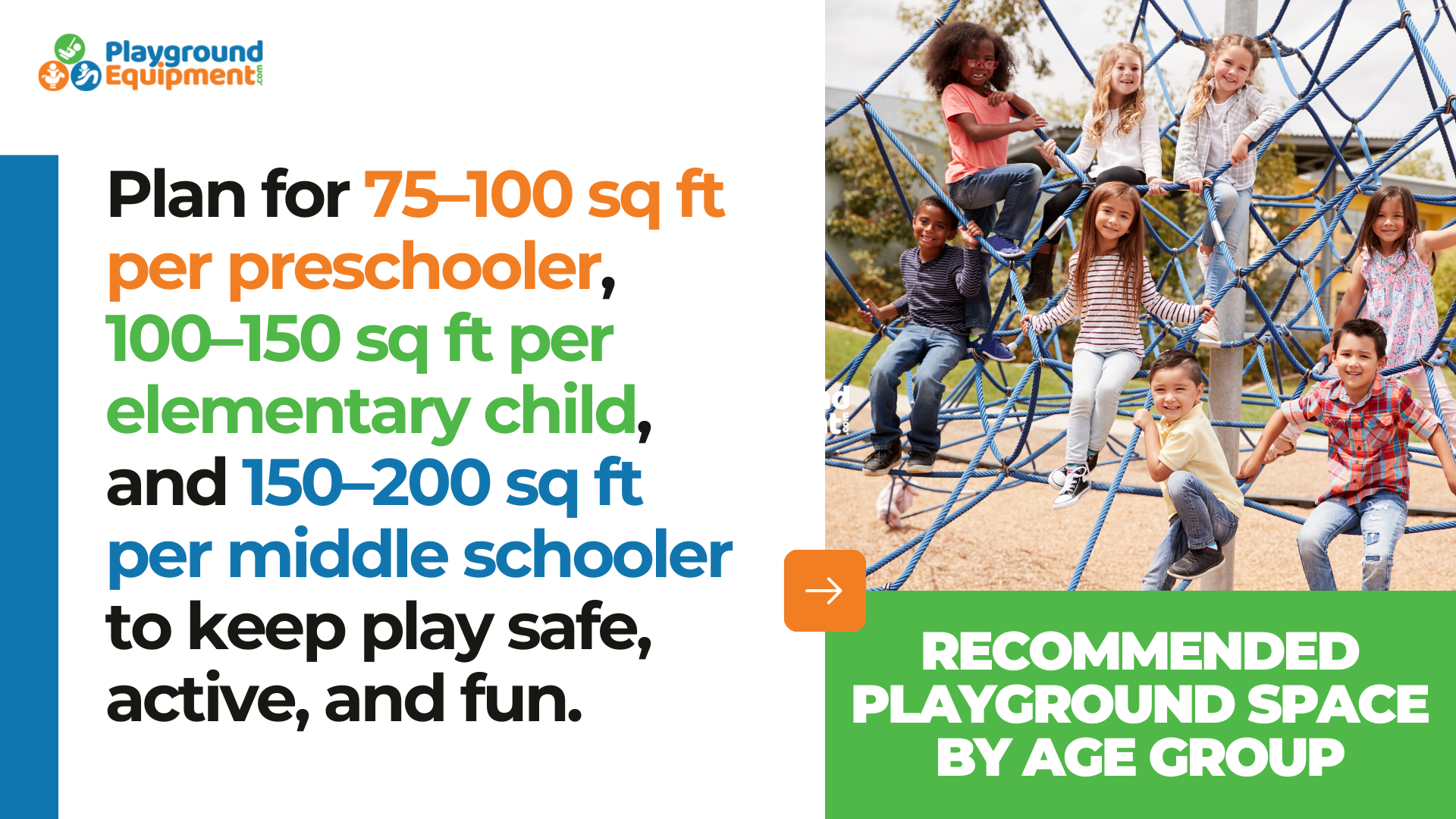
Different age groups play differently — and their playgrounds should reflect that. When determining the ideal playground size, age-based planning ensures both safety and fun.
Early Childhood (Ages 2–5)
Preschoolers are all about exploration and imagination. They don’t need a huge field, but they do need space to crawl, balance, and build coordination.
- Recommended Space: 75–100 sq. ft. per child
- Typical Features: Low slides, playhouses, activity panels, and sensory play zones
- Pro Tip: Include soft surfaces, low platforms, and sensory panels
At this age, smaller zones packed with interactive play equipment encourage learning through movement — something PlaygroundEquipment.com specializes in with our inclusive, developmental designs.
Elementary (Ages 5–12)
Elementary-age children crave challenge and adventure. They need areas for climbing, swinging, spinning, and social play.
- Recommended Space: 100–150 sq. ft. per child
- Typical Features: Monkey bars, rope climbers, obstacle courses, and combination play structures
- Pro Tip: Create distinct play zones for younger vs. older elementary students
The key is variety. Our modular systems enable schools to customize layouts that strike a balance between physical development and imaginative play — ensuring every student finds their favorite spot.
Middle School (Ages 12+)
Older kids need active recreation and group spaces that support sports, movement, and social interaction.
- Recommended Space: 150–200 sq. ft. per student
- Typical Features: Fitness stations, basketball courts, and open turf for team games
- Pro Tip: Incorporate fitness-focused equipment to promote lifelong wellness habits
PlaygroundEquipment.com offers durable, fitness-focused equipment designed to meet the unique needs of middle schoolers — keeping them engaged and moving, even beyond recess.
Making the Most of Limited Space
Not every school has acres of open land—but that doesn’t mean you can’t build an incredible playground. Smart design can transform compact spaces into high-impact play zones.
Vertical Play
When the ground area is limited, go upward. Vertical climbing walls, towers, and elevated platforms create new play experiences without requiring extra square footage.
Multi-Functional Equipment
Combination units—like a slide-climber with integrated monkey bars—maximize fun without increasing footprint.
Natural Play Elements
Natural landscapes—like grassy mounds, logs, or stepping stones—add sensory and imaginative play without consuming large space. They also blend beautifully with the environment and require minimal maintenance.
Creative Surfacing
Bright, patterned rubber surfacing can visually expand the space, delineate play zones, and add safety—all in one design element.
At PlaygroundEquipment.com, we specialize in designing compact playgrounds that feel spacious, dynamic, and endlessly fun.
How PlaygroundEquipment.com Helps You Get It Right
There's no universal answer to the question of ideal playground size because every school serves a unique community with distinct needs, constraints, and aspirations. However, the principles remain constant: prioritize safety through adequate spacing, serve your entire student population with diverse play types and learning opportunities, and build flexibility for future evolution.
PlaygroundEquipment.com makes that balance possible. With our deep knowledge of safety standards, design best practices, and equipment engineering, we help schools nationwide build playgrounds that feel perfectly sized for their students’ needs—and their long-term goals.
Contact us today for more information, and let’s create the space that fits your students and your vision perfectly. Because when the playground fits just right, everyone wins.
Unlock the Secrets of Great Play Spaces Through These Expert Picks
- Because branding plays an important role for schools and community spaces:
- For more ways of understanding design safety parameters:
- Learn why neutrals can also be great playground design:
- For more tips on choosing the right equipment size:
- Learn about the common playground equipment installation methods:
Learn About the Author

Nicolas Breedlove, founder and CEO of PlaygroundEquipment.com, transformed a small business into an industry leader known for its superior-quality products and strong distribution network. Drawing on early experiences in various roles, Nic's customer-centric approach and entrepreneurial spirit have set his company apart. Under his leadership, PlaygroundEquipment.com continues to thrive, delivering innovative, safe, and durable playground solutions.
Nicolas on linkedin